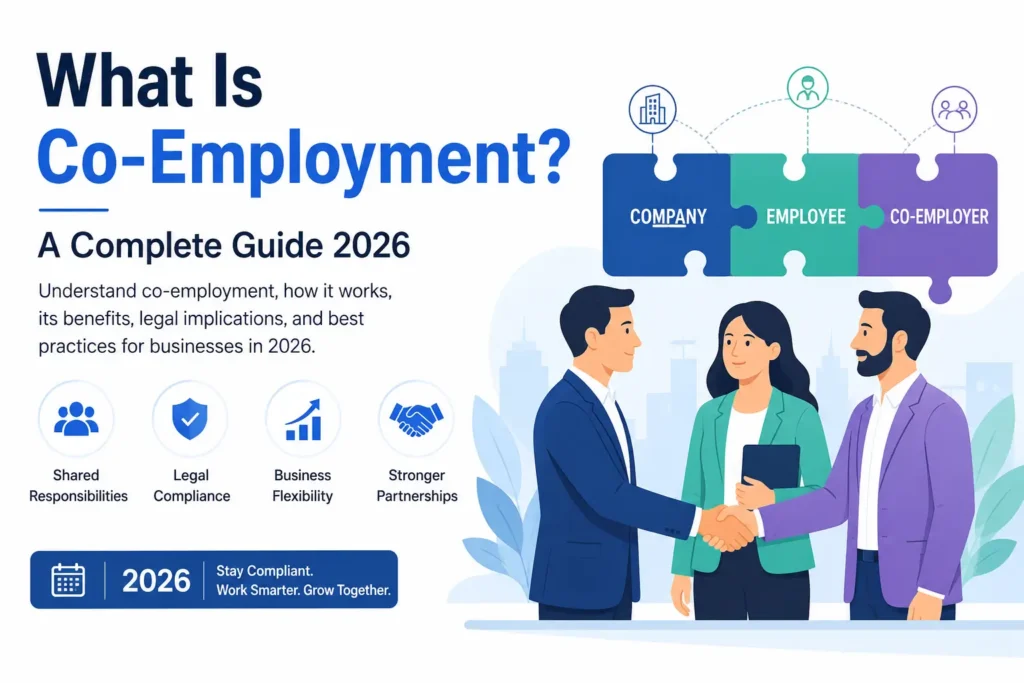
Co-employment is a working relationship in which a business and a professional employer organization divide specific employer duties under a signed agreement. The client keeps control of daily operations, hiring, and management, while the PEO takes on payroll, benefits administration, and compliance filings.
For a growing company, this split matters more than it sounds. HR requirements shift every year, benefit costs keep climbing, and a single missed filing can turn into a real penalty. Co-employment gives smaller teams a way to hand off that administrative weight without giving up their identity as an employer.
This guide walks through what co-employment actually looks like day to day, how it differs from arrangements it’s often confused with, who carries liability when something goes wrong, and how to judge whether it fits your business heading into 2026.
What Is Co-Employment?
Co-employment is a contractual arrangement where a business and a PEO each hold defined employer responsibilities for the same group of workers. It is not a transfer of ownership, and it is not a staffing arrangement. It is a division of labor, spelled out in writing before either side takes on a single task.
The confusion usually starts with the word itself. “Co-employment” sounds like it means two companies jointly run the same workforce, with neither one fully in charge. In practice, the split is much more specific than that, and each side knows exactly where its responsibility starts and ends.
Here’s how the responsibilities typically break down:
| Function | Handled by the client | Handled by the PEO |
|---|---|---|
| Hiring and firing decisions | Yes | No |
| Daily work assignments and supervision | Yes | No |
| Payroll processing and tax filings | No | Yes |
| Benefits enrollment and administration | No | Yes |
| Workers’ compensation coverage | No | Yes |
| Company culture and business strategy | Yes | No |
The client runs the business. The PEO runs the paperwork behind employing people. Both roles are real, and both come with accountability, but they don’t overlap.
How Does Co-Employment Work in Practice?
The relationship starts with a signed contract, usually called a Client Service Agreement, and it becomes active once payroll actually moves through the PEO’s system rather than the client’s own accounts.
The Client Service Agreement
This document is where the entire arrangement gets defined. It lists which tasks belong to the PEO, which stay with the client, how billing works, and what happens if either side wants to end the relationship. Read it closely before signing, since vague language here tends to cause disputes down the road.
When the Relationship Officially Begins
Signing the agreement doesn’t flip a switch overnight. Most businesses spend several weeks transferring employee records, setting up benefit plans, and testing payroll before the PEO processes its first live payroll run. Co-employment is considered active once that first run goes through cleanly.
The Day-to-Day Split
Once the arrangement is live, employees still show up, report to their same manager, and get evaluated the same way they always have. What changes is what happens behind the scenes: their paycheck, their tax withholdings, and their benefits enrollment now route through the PEO’s systems instead of an internal payroll department.
Is Co-Employment Legal?
Yes, co-employment is a legal and widely used arrangement across the United States. There is no single federal statute called a “co-employment law,” but the relationship still has to comply with existing labor and tax frameworks that apply to any employer.
Three frameworks come up most often. The Fair Labor Standards Act governs wage and overtime rules for both parties. The Federal Insurance Contributions Act covers how payroll taxes get withheld and remitted. The Employee Retirement Income Security Act applies if the PEO administers retirement benefits like a 401(k) match.
None of these frameworks were written specifically for PEOs, but courts and regulators have applied them to co-employment arrangements for decades. A properly structured agreement accounts for all three, which is one reason the contract itself deserves careful review before signing.
Does Co-Employment Mean You Lose Control of Your Business?
No. This is the single most common misunderstanding about co-employment, and it’s worth addressing directly before going any further. Entering a co-employment agreement does not transfer ownership, decision-making authority, or day-to-day management away from the client company.
You still decide who gets hired. You still decide who gets let go. You still set the schedule, assign the work, and shape the culture your team operates in. The PEO has no seat at that table, and a properly structured agreement makes that boundary explicit rather than implied.
What the PEO takes on instead is the administrative machinery sitting underneath those decisions: calculating withholdings correctly, keeping benefit plans compliant, and filing paperwork on time. It’s support infrastructure, not a management layer. Businesses that understand this distinction get far more value out of the relationship.
Co-Employment vs. Joint Employment: What’s the Difference?
These two terms get used interchangeably far too often, and the mix-up creates real confusion for business owners trying to research their options. They describe fundamentally different legal relationships with different liability structures.
| Co-Employment | Joint Employment | |
|---|---|---|
| How it forms | Voluntary, defined by signed contract | Often arises unintentionally from shared control |
| Typical parties | Business and a PEO | Staffing agency, contractor, or multiple businesses |
| Responsibility split | Clearly divided in advance | Frequently overlapping or disputed |
| Liability | Shared, but scoped to each party’s role | Both parties can be held fully liable together |
Joint employment tends to show up in staffing and contracting relationships, where two companies both direct a worker’s tasks without ever formalizing who owns which responsibility. That ambiguity is exactly what a co-employment agreement is designed to prevent from the start.
Is a PEO the Same as Co-Employment?
Not quite, though the two terms travel together so often that people use them as if they mean the same thing. Co-employment is the structure. A PEO is the organization that carries it out.
Think of it this way: co-employment describes the relationship, and a PEO is one specific type of provider built to operate inside that relationship. Not every HR vendor works this way. Traditional HR outsourcing firms handle tasks without becoming a co-employer, which means they never share the compliance liability a PEO takes on.
Employee leasing companies are another example worth separating out. They supply workers on an ongoing basis, which is a different service model entirely from a PEO managing the employees a client has already hired and continues to hire on their own.
PEO vs. Employer of Record: Where Co-Employment Fits
The clearest way to tell a PEO apart from an Employer of Record is to look at who legally employs the worker on paper. A PEO shares that role through co-employment. An EOR takes on the entire legal employer role by itself, with no shared structure at all.
This distinction matters most when a business wants to hire someone in a country where it has no legal entity. A PEO requires the client to already have a registered business presence in that location, since the co-employment model depends on both parties sharing responsibility locally.
An EOR removes that requirement entirely by becoming the sole legal employer in the worker’s country. There’s no co-employment involved, no shared liability structure, and no need for the client to establish a local entity before hiring someone there.
Who Is Liable in a Co-Employment Relationship?
Liability in co-employment follows the same line as responsibility. Each party is accountable for the functions it actually controls, not for decisions made entirely by the other side of the agreement.
The PEO typically carries liability for payroll accuracy, tax filing deadlines, and benefits plan compliance, since those are the functions it directly manages. If a filing gets missed or a withholding calculation is wrong, that responsibility sits with the PEO under most agreements.
The client retains liability for workplace decisions: who gets hired, how performance gets managed, and whether the work environment meets safety and conduct standards. A well-drafted Client Service Agreement spells out exactly where this line falls so neither side is guessing after the fact.
What Are the Risks of Co-Employment?
Co-employment isn’t risk-free, and pretending otherwise does a disservice to any business considering it. The risks are manageable, but they deserve real attention before signing an agreement.
Misclassification Risk
Getting worker classification wrong, particularly the line between employee and independent contractor, creates liability that follows the business regardless of what the PEO handles. This has to be sorted out before onboarding starts, not discovered afterward.
Reduced Visibility
Handing payroll and compliance to an outside party means fewer internal eyes on the details. Some businesses find it harder to spot pay discrepancies or catch compliance gaps early when the process runs through someone else’s system.
Choosing an Unaccredited Provider
Not every PEO carries the same level of financial oversight. Working with a provider that lacks IRS certification or ESAC accreditation raises the odds of running into a partner that can’t back up its own compliance claims.
Each of these risks has a practical fix: verify classification before onboarding, ask for regular reporting access, and confirm certification status before signing anything.
What Responsibilities Does a PEO Take On?
A PEO’s role centers on the administrative load that sits underneath employing people. The specific list varies by provider and contract, but most agreements cover a consistent core set of functions:
- Processing payroll and issuing paychecks on schedule
- Filing payroll taxes with federal and state agencies
- Administering health insurance and other employee benefits
- Managing workers’ compensation coverage and claims
- Guiding compliance with wage, hour, and workplace regulations
- Advising on HR policy without making final decisions for the client
This list is what most businesses picture when they think about a PEO, and it’s the reason the arrangement appeals to companies without an in-house HR department capable of covering all of it alone.
What Happens to Payroll and Taxes Under Co-Employment?
Under co-employment, the PEO typically processes payroll using its own tax identification number for reporting purposes, while wages still originate from work performed for the client’s business. Employees are paid on schedule, with taxes withheld and remitted by the PEO.
This structure is what allows a PEO to file employment taxes on behalf of many client businesses at once, often with fewer errors than a smaller internal team managing it alone. The client still funds payroll, but the reporting and filing mechanics run through the PEO’s infrastructure.
Is Co-Employment Right for Your Business?
There’s no universal answer here, but a few signals tend to point toward co-employment being worth exploring. Run through this checklist honestly before making a decision either way.
- Your team spends more time on HR administration than on work that grows the business
- Your current benefits package can’t compete with larger employers in your industry
- Compliance requirements have grown faster than your internal capacity to track them
- You’re scaling headcount and don’t want to build an HR department from scratch
- You want workers’ compensation and risk management handled by specialists
If most of these apply, co-employment through a PEO is worth a serious look. If your internal HR function already covers this ground well, the value proposition shrinks considerably.
Frequently Asked Questions
Can I switch PEOs without disrupting co-employment?
Yes. Transitioning between PEOs is common and doesn’t require ending co-employment altogether. It does require careful timing around payroll cycles and benefits enrollment to avoid gaps in coverage.
Do my employees work for the PEO or for me?
Both, in a specific sense. Employees remain part of your business day to day, reporting to your managers and doing your work, while the PEO handles their administrative employment functions like payroll and tax filing.
What size business benefits most from co-employment?
Small and mid-sized businesses see the most value, typically those without the internal headcount to justify a full HR department. Larger companies sometimes use co-employment too, mainly for specific compliance or benefits advantages.
Does co-employment change how employees get paid?
The payment source doesn’t change, but the payroll processing and tax reporting route through the PEO’s systems instead of an internal payroll department. Employees generally notice no difference in their pay schedule.
What happens if the PEO relationship ends?
Responsibilities transfer back to the client, who then needs a plan for handling payroll, benefits, and compliance internally or through a new provider. Most agreements outline a transition period to manage this handoff.
Co-employment isn’t a shortcut around good HR practice, and it isn’t a loss of control either. It’s a structured way to share specific administrative responsibilities with a partner built to handle them, while your business stays focused on the decisions that actually move it forward.
If you’re weighing whether this model fits where your business is headed in 2026, the details in your Client Service Agreement will matter more than the general concept. Take the time to understand exactly what’s being divided before you sign anything.