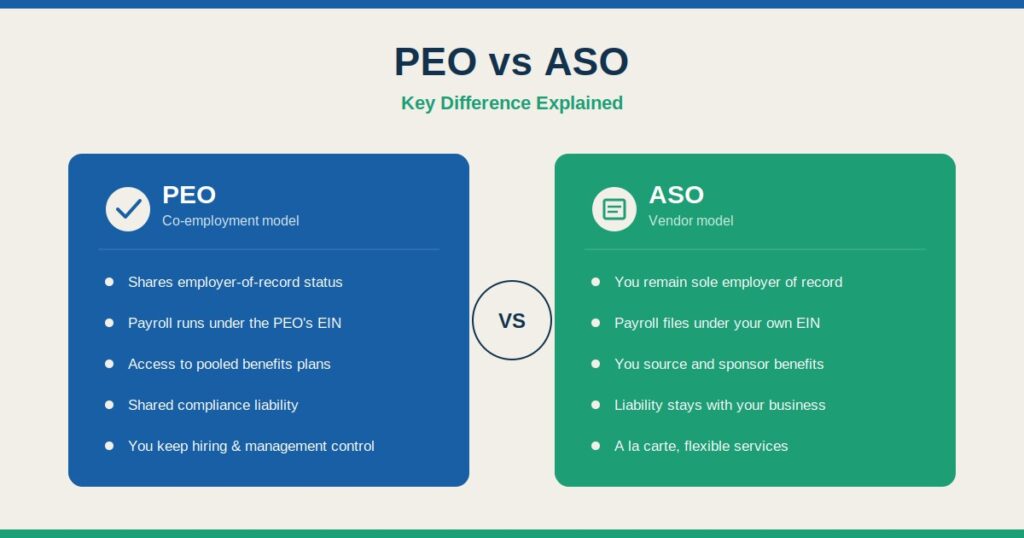
The moment a growing company starts weighing HR outsourcing, two acronyms show up almost immediately: PEO and ASO. They get used interchangeably by people who haven’t looked closely at either one, which is part of why the confusion sticks around. Here’s the short version: a PEO becomes a co-employer of your workforce, while an ASO stays a vendor and never touches that employer status. That one distinction — co-employment or not — is what separates every other difference between the two models, from who signs the tax filings to who’s on the hook when something goes wrong.
If you’re trying to decide which one fits your business, the rest of this guide walks through what each model actually does, where they diverge on payroll, benefits, liability, and cost, and how to think through the choice without guessing.
What Is a PEO?
A Professional Employer Organization enters into a co-employment relationship with your business. That phrase sounds bigger than it is in practice. Your company still runs the show — you hire, you fire, you decide who gets promoted and what the culture looks like. What changes is who sits behind the paperwork.
Once the agreement is signed, the PEO becomes the employer of record for tax and administrative purposes. Payroll runs under the PEO’s own EIN. The PEO sponsors your health benefits, often through a large pooled plan that gives a 40-person company access to pricing normally reserved for much bigger employers. It carries the workers’ compensation policy. It files the payroll taxes. And because it’s sharing employer status, it also shares a slice of the legal exposure that comes with employing people.
For a business without an internal HR function, that bundle solves a lot of problems at once — not by adding headcount, but by handing the administrative and compliance weight to a partner built to carry it.
What Is an ASO in HR?
An Administrative Services Organization does a version of the same work — payroll processing, benefits coordination, HR guidance — but it stops short of becoming your co-employer. Your company keeps its own EIN. You stay the sole employer of record. The ASO supports the tasks; it doesn’t absorb the liability that comes with them.
Think of it less as a partner and more as a specialized vendor you’ve hired to handle specific pieces of HR administration. You pick which services you want. The ASO executes them. But if a payroll tax filing goes wrong or a compliance deadline gets missed, that responsibility sits with your business, not the ASO.
This model tends to make sense for companies that already have an HR person or team in place — someone who understands the workforce and the compliance landscape but is spending too many hours on administrative tasks that don’t require their judgment.
PEO vs ASO: Key Differences
The co-employment question shapes almost everything downstream. Here’s how that plays out across the areas that matter most when you’re comparing the two.
Employer of Record and Co-Employment
With a PEO, the PEO becomes employer of record for tax and benefits purposes, even though your business still directs day-to-day work. With an ASO, there’s no shift in employer status at all — you remain the employer of record from start to finish, and the ASO simply provides support around that role.
Payroll and Tax Filing
A PEO processes payroll and remits taxes under its own EIN. Your employees’ pay stubs and tax documents reflect the PEO’s identity for administrative purposes. An ASO processes payroll too, but the filings go out under your company’s EIN — which means any error in that filing is still your business’s problem to fix.
Benefits and Insurance
PEOs typically sponsor a master benefits plan built from the combined size of every client company on their roster. That pooled scale is what lets a small business offer benefits that would otherwise be out of reach. An ASO can help you shop for and administer a plan, but you’re sourcing and sponsoring it yourself — there’s no shared pool working in your favor.
Liability and Risk
Co-employment means shared responsibility. A PEO takes on part of the legal and financial exposure tied to payroll errors, benefits administration, and certain compliance failures. An ASO doesn’t share that exposure — it can guide you and flag issues, but the liability stays entirely with your company.
Control Over HR Decisions
This is where a lot of business owners hesitate, and it’s worth addressing directly: partnering with a PEO does not mean handing over control of your workforce. You still make every decision about hiring, discipline, scheduling, and performance. The PEO’s role is limited to the administrative and compliance layer sitting underneath those decisions — not the decisions themselves.
PEO vs ASO Cost Comparison
Pricing structures differ enough that a side-by-side dollar comparison can be misleading without context.
PEOs commonly charge either a percentage of total payroll — often somewhere between 2% and 12% — or a flat per-employee-per-month fee. That number usually bundles in benefits administration, workers’ comp coverage, and payroll tax handling, so it’s covering more ground than the headline figure suggests.
ASOs are typically billed per employee per month, often in a lower range on paper. But that fee generally doesn’t include benefits or workers’ comp premiums — those get sourced and paid separately, which means the full cost of running HR through an ASO can end up closer to a PEO’s total than the sticker price implies.
The more useful question isn’t which model has the lower fee. It’s which model gets you to a lower total cost once benefits, compliance risk, and the hours your team spends on administration are all counted.
PEO vs ASO vs HRO: How Does HRO Fit In?
Human Resources Outsourcing, or HRO, is the broader category both PEOs and ASOs fall under. It’s not a third distinct model competing with the other two — it’s the umbrella term for outsourcing HR functions to any third party. In practice, a lot of providers use “HRO” and “ASO” interchangeably, since both describe administrative support without co-employment. If you see a provider marketed as an HRO, it’s worth asking directly whether they operate on a co-employment basis or not — that answer tells you whether you’re really looking at a PEO or an ASO under a different label.
How to Choose Between a PEO and an ASO
A few questions tend to surface the right answer faster than a feature-by-feature comparison:
- Do you have someone internally who owns HR? If not, a PEO’s full-service model fills that gap. If you do, an ASO can free up that person’s time without duplicating what they already handle well.
- How many states do you operate in? Multi-state payroll and compliance get complicated fast. PEOs are generally built to absorb that complexity; ASOs can support it, but the compliance burden stays with you.
- How much risk can your business comfortably carry? If shared liability and reduced compliance exposure matter more than retaining full control, that points toward a PEO. If you’d rather keep full authority and are equipped to manage the risk that comes with it, an ASO fits better.
- What’s your growth trajectory? Companies expecting to add headcount quickly, especially across new states, often lean toward a PEO for the built-in compliance infrastructure. Companies with steady, predictable growth and an established HR function often stay with an ASO longer.
It’s also common for a business to start with a PEO to get compliant quickly, then transition to an ASO once an internal HR function matures enough to take on more of that responsibility directly. Neither model is a permanent commitment — it’s a fit for where the business is right now.
Frequently Asked Questions
Is HRO the same thing as an ASO?
HRO is the broader category; ASO is one type of HRO provider. Many providers use the terms interchangeably, but the important distinction is always whether co-employment is involved — that’s what actually separates an ASO from a PEO.
What happens to my payroll taxes if I use an ASO instead of a PEO?
Your company files under its own EIN either way with an ASO. The ASO processes the payroll and can guide the filing, but the tax liability and responsibility for accuracy stay with your business, not the provider.
When should a business switch from an ASO to a PEO?
Common triggers include expanding into new states, outgrowing your current benefits options, or reaching a point where compliance risk has grown beyond what your internal HR team can comfortably manage alone.
Do I lose control of my employees with a PEO?
No. Co-employment covers administrative and tax functions only. Hiring, firing, scheduling, performance management, and company culture stay entirely under your control.
Which is cheaper, a PEO or an ASO?
The per-employee fee is often lower with an ASO, but that fee typically excludes benefits and workers’ comp. Once those costs are added in, the total cost gap between the two models is usually smaller than it first appears.
The Bottom Line
Every difference between a PEO and an ASO traces back to one decision: whether the provider shares employer status with you or not. A PEO takes on co-employment and, with it, a share of the administrative burden, the benefits scale, and the liability. An ASO stays a vendor, giving you more control at the cost of keeping full responsibility. Neither is the better model in the abstract — the right one depends on where your business stands today, and that’s worth working through with a clear head before signing anything.